K-Doped Tungsten Wire
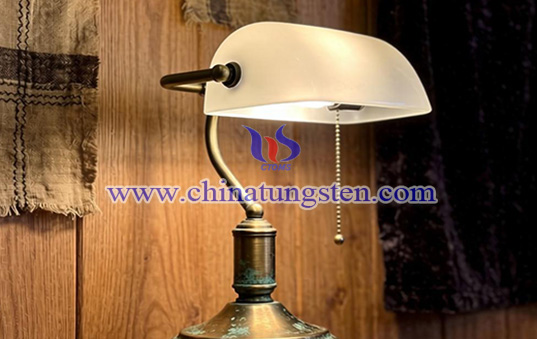
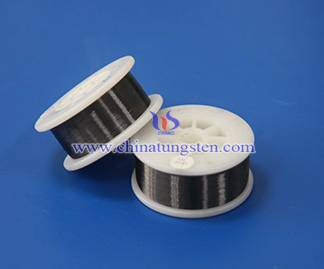
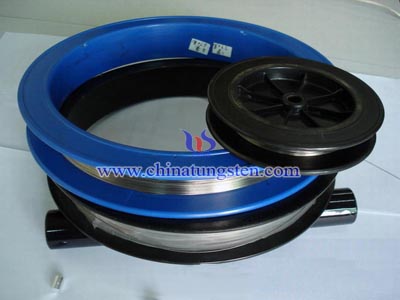
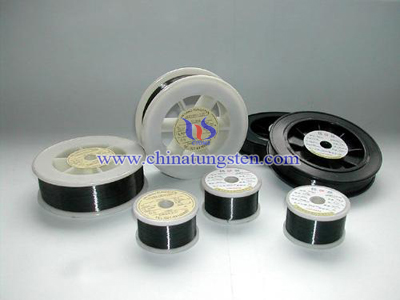
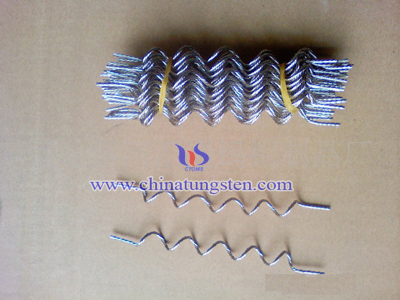
K-doped tungsten wire refers to tungsten wire in which trace potassium (K) is introduced into a tungsten matrix, typically at levels of 10 to 80 ppm, and is produced through powder metallurgy, sintering, rotary swaging, and multi-pass wire drawing processes. It is mainly used in high-temperature environments where sag resistance, creep resistance, and structural stability are required, such as incandescent and halogen lamp filaments, electron tube heating filaments, vacuum furnace heating elements, and evaporation coating support structures.
Based on CTIA’s manufacturing experience, the high-temperature stability of K-doped tungsten wire mainly comes from the synergistic effect of elongated bubble-chain structures and texture alignment formed during processing, which enables the tungsten wire to maintain good shape stability and resistance to deformation at elevated temperatures.
1. Structure of K-Doped Tungsten Wire
K-doped tungsten wire is based on high-purity tungsten with potassium content at the ppm level. Potassium does not enter solid solution during sintering and high-temperature deformation but exists as closed bubbles at the nanometer scale, typically around 10 to 100 nm. During swaging and wire drawing, these bubbles are elongated and aligned along the deformation direction, forming continuous bubble-chain structures. These structures act as stable barriers at grain boundaries, suppress grain boundary migration and delay recrystallization, resulting in a fibrous microstructure with a grain aspect ratio typically greater than 10. The continuity and uniformity of bubble chains are critical to performance stability.
2. Properties of K-Doped Tungsten Wire
K-doped tungsten wire exhibits excellent creep resistance and sag resistance at high temperatures. Its recrystallization temperature is approximately 1600 to 1800°C, while full recrystallization occurs at about 1900 to 2100°C. Even above 2000°C, part of the deformation-processed structure can still be retained, slowing performance degradation. The bubble-chain structure reduces grain boundary sliding under high-temperature loading above 2000°C, decreasing creep rate by approximately 30 to 60% at 2400°C. At 2200 to 2600°C under long-term loading, deformation remains low, providing strong sag resistance suitable for filaments and suspended structures.
3. Specifications of K-Doped Tungsten Wire
The diameter range of K-doped tungsten wire is typically 0.01 mm to 1.5 mm. Ultra-fine wires can reach the micrometer scale; for example, in high-end applications such as photovoltaic tungsten wire, wire diameters are typically 15 to 35 μm, while filament applications commonly use 10 to 50 mm. Common grades include WK30 and WK60, as well as WB001 and WB150 for lighting applications. Different grades are optimized for high-temperature sag resistance, vibration resistance, or processing performance.
4. K-Doped Tungsten Wire vs. Other Tungsten Wires
Compared with pure tungsten wire, K-doped tungsten wire improves high-temperature dimensional stability by delaying recrystallization through its bubble-chain structure, making it more suitable for applications above 2200°C. Compared with rare earth tungsten wire, its strengthening mechanism relies on bubble-chain constraints on grain boundaries rather than oxide dispersion strengthening, focusing more on structural stability and sag resistance. Compared with tungsten rhenium wire, which improves ductility through solid solution strengthening, K-doped tungsten wire emphasizes shape retention under long-term high-temperature service conditions.
5. Applications of K-Doped Tungsten Wire
K-doped tungsten wire is mainly used in high-temperature lighting, vacuum electronic devices, vacuum furnaces, evaporation coating systems, and high-temperature processes in photovoltaics and semiconductors.
5.1 High-temperature lighting
Used as filaments in incandescent and halogen lamps, with operating temperatures typically ranging from 2400 to 3000°C. Shape stability under self-weight is critical, and the bubble-chain structure helps reduce sagging and deformation.
5.2 Vacuum electronic devices
Used as filaments or support structures in electron tubes, operating under vacuum conditions of 10⁻⁵ to 10⁻⁷ Pa. Long-term heating requires stable geometry and low vapor pressure.
5.3 Vacuum furnaces and evaporation coating systems
Used as heating elements or support components at approximately 1800 to 2600°C. Creep resistance directly affects structural stability under continuous loading.
5.4 Photovoltaic and semiconductor high-temperature processes
Used for auxiliary heating or structural support. Under repeated thermal cycling, stable microstructural response is required to minimize deformation accumulation.
K-doped tungsten wire is mainly used in high-temperature load-bearing and structural stability applications. Selection is generally determined by operating temperature, mechanical load, and service life requirements. Based on these parameters, CTIA optimizes wire specifications and processing conditions to ensure stable performance and suitability for specific applications.
For any inquiry, please contact tungsten wire manufacturer: CTIA GROUP
Email: sales@chinatungsten.com
Tel: 0086 592 5129696 / 0086 592 5129595
Website: www.tungsten.com.cn
WeChat:

Related Products: