Tungsten Wire vs. Molybdenum Wire
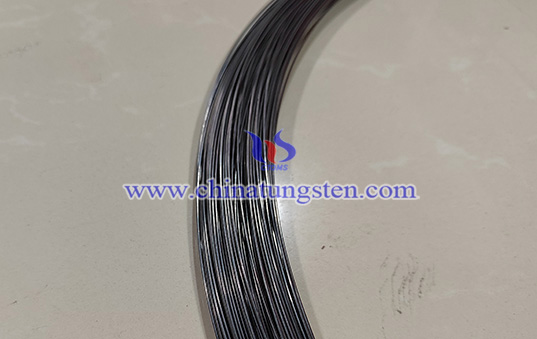
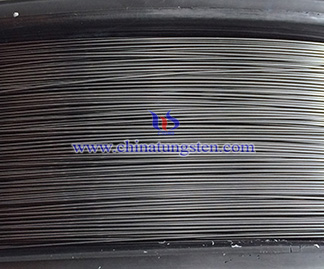
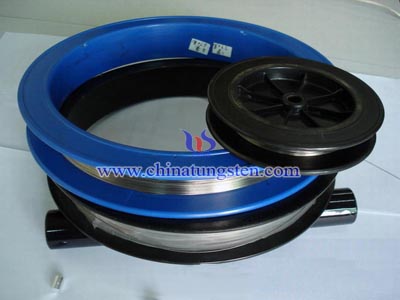
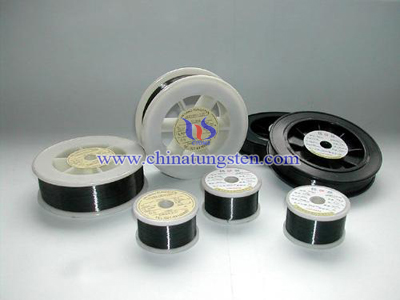
Tungsten wire and molybdenum wire are two key representatives of refractory metal wires. Tungsten wire is produced from high-purity tungsten powder through powder metallurgy, hot isostatic pressing, and multiple cold drawing processes, enabling excellent structural stability under extreme high temperatures and heavy loads. Molybdenum wire is made from high-purity molybdenum powder, offering good ductility, machinability, and stable high-temperature and electrical performance. From CTIA’s perspective, material selection should consider physical and chemical properties, mechanical behavior, processing methods, and application environments to ensure performance matches engineering requirements.
1. Physical and Chemical Properties Comparison of Tungsten Wire and Molybdenum Wire
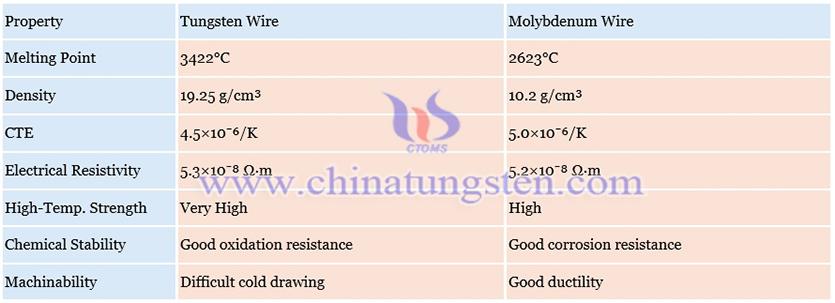
Tungsten wire and molybdenum wire differ in melting point, density, thermal expansion, and chemical stability. Tungsten wire is suited for ultra-high-temperature environments, while molybdenum wire, with lower density, is preferred for weight-sensitive applications. Electrical conductivity is similar, though molybdenum offers slight advantages in certain conductive uses. Tungsten forms a protective oxide layer, whereas molybdenum performs well in corrosive environments. CTIA considers both intrinsic properties and service conditions, including oxidation, thermal cycling, and mechanical loading, to provide reliable, application-oriented material selection guidance. The physical and chemical properties comparison of tungsten wire and molybdenum wire is shown as the picture below:
2. Mechanical and Processing Comparison of Tungsten Wire and Molybdenum Wire
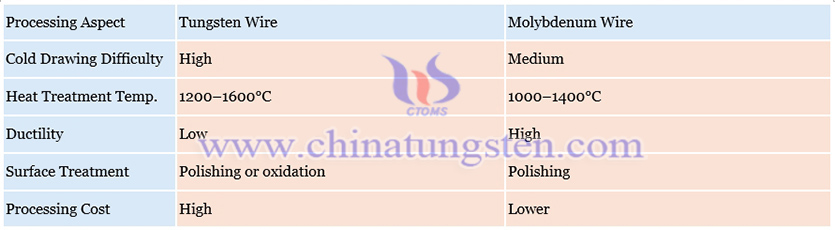
Tungsten wire retains high strength at elevated temperatures but is brittle at room temperature, requiring strict cold drawing and heat treatment. Molybdenum wire offers better ductility and withstands repeated bending and cyclic loading, making it suitable for precision components and complex structures. Tungsten wire is available as cleaned tungsten wire or black tungsten wire, while molybdenum wire has a naturally smooth surface suitable for electrodes and precision parts. Tungsten processing is more complex and energy-intensive, whereas molybdenum wire is more efficient and cost-effective. CTIA optimizes drawing and heat treatment processes based on material characteristics to ensure stable performance and balanced manufacturing efficiency. The mechanical and processing properties comparison of tungsten wire and molybdenum wire is shown as the picture below:
3. Application Comparison of Tungsten Wire and Molybdenum Wire
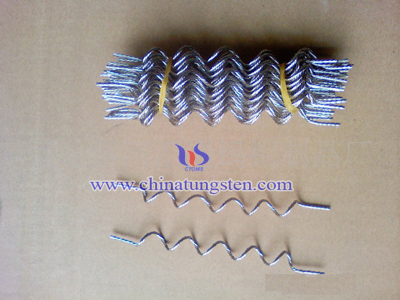
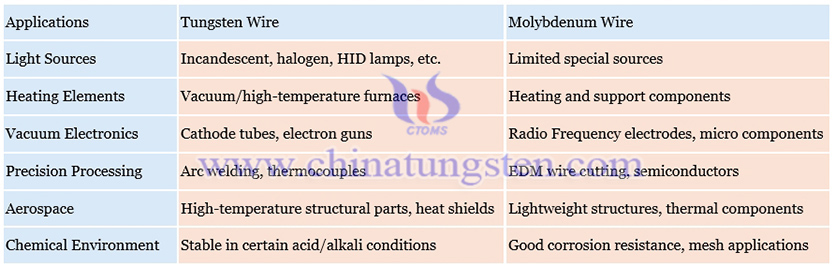
Tungsten wire is widely used in high-temperature light source filaments such as High Intensity Discharge (HID) lamps, vacuum electronic devices, heating elements, aerospace structures, and precision processes requiring thermal stability. Molybdenum wire is applied in precision machining, EDM (Electrical Discharge Machining) wire cutting, semiconductor manufacturing, lightweight structures, and corrosive environments. CTIA recommends selection based on application conditions; tungsten wire offers long-term stability in high-temperature vacuum furnaces, while molybdenum wire is better suited for lightweight electronic structures due to its machinability and cost efficiency. The application characteristics comparison of tungsten wire and molybdenum wire is shown as the picture below:
4. Manufacturing and Cost Comparison of Tungsten Wire and Molybdenum Wire
Tungsten wire requires complex processing with strict drawing and heat treatment requirements, resulting in higher manufacturing costs. Molybdenum wire is easier to process, offers higher production efficiency, and has lower cost. CTIA optimizes process parameters based on application requirements to ensure dimensional accuracy, surface quality, and high-temperature performance, providing reliable long-term material solutions.
In a word, tungsten wire is preferred for extremely high temperatures and long-term high-strength use. Molybdenum wire is more suitable for applications requiring ductility, fatigue resistance, conductivity, or cost efficiency. In precision machining, semiconductors, and microelectronics, molybdenum wire is favored for its machinability and light weight. In lighting, vacuum electronics, and high-temperature aerospace structures, tungsten wire remains irreplaceable due to its high melting point and strength stability. CTIA optimizes drawing, heat treatment, and surface finishing to ensure dimensional accuracy, surface quality, and long-term performance across applications.
For any inquiry, please contact tungsten wire manufacturer: CTIA GROUP
Email: sales@chinatungsten.com
Tel: 0086 592 5129696 / 0086 592 5129595
Website: www.tungsten.com.cn
WeChat:

Related Products: