Manufacturing Process of CTIA's Tungsten Wire
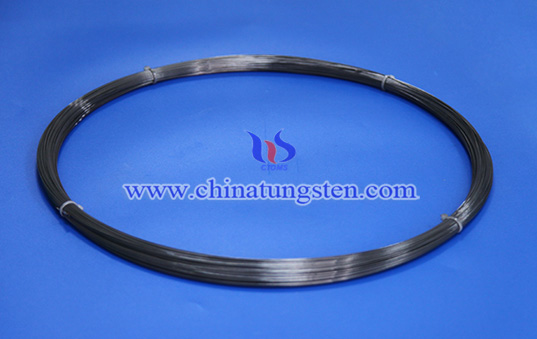
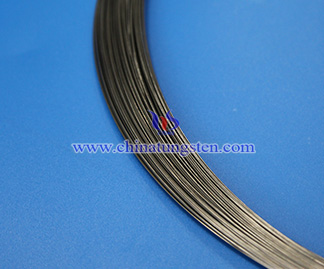
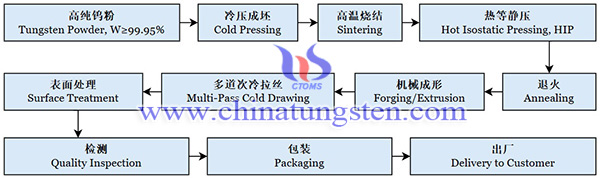
CTIA focuses on the production of high-performance tungsten wire and has established a complete manufacturing system from high-purity raw materials to finished wire. The process covers powder metallurgy, sintering, hot isostatic pressing, annealing, mechanical forming, and multi-pass drawing. Each stage is precisely controlled to ensure stable and reliable performance in demanding environments such as high temperature, vacuum, and electron emission. Through continuous process optimization, CTIA's tungsten wire achieves advantages in diameter uniformity, high purity, smooth surface, and consistent mechanical properties.
1. CTIA's Tungsten Wire Manufacturing Process / Raw Material Preparation
Tungsten wire production starts with high-purity tungsten powder (W≥99.95%). CTIA controls particle size distribution, chemical purity, and impurity levels. Uniform powder reduces pore formation during sintering, improving density and drawability. Oxygen and carbon are key parameters affecting high-temperature resistance, conductivity, and mechanical performance. The powder undergoes multiple screening and chemical analyses to remove harmful impurities. CTIA also adjusts composition and particle grading for applications such as electron emission and microelectronic components.
2. CTIA's Tungsten Wire Manufacturing Process / Powder Metallurgy
High-purity tungsten powder is cold-pressed into billets and sintered at 2500–2700°C in hydrogen or vacuum atmosphere. Particles bond into a dense structure with uniform grain distribution, forming tungsten blocks with excellent thermal and electrical properties. CTIA controls temperature, holding time, and atmosphere to minimize oxidation and impurity diffusion. The resulting blocks have high density and mechanical integrity, providing a stable foundation for further processing.
3. CTIA's Tungsten Wire Manufacturing Process / Hot Isostatic Pressing (HIP)
Sintered billets undergo HIP to further increase density and remove internal porosity. It is performed at ~2500°C under 100–200 MPa, improving mechanical strength, creep resistance, and thermal conductivity. HIP enhances deformation stability during drawing, reduces wire breakage and surface cracking, and refines grain structure to meet industrial requirements.
4. CTIA's Tungsten Wire Manufacturing Process / Annealing and Mechanical Forming
After HIP, billets are annealed to relieve internal stress and optimize grain structure, then processed into coarse wire rods via cutting, forging, or extrusion of typically φ1–5 mm. CTIA controls temperature, deformation rate, and surface condition to ensure uniform structure and defect-free billets. Parameters are adjusted for different applications, such as heating and electron emission wires, supporting precision drawing.
5. CTIA's Tungsten Wire Manufacturing Process / Multi-pass Cold Drawing
Coarse wire rods are reduced to target diameters through multi-pass cold drawing. Each pass uses lubrication and intermediate annealing to reduce stress, improve surface finish, and maintain dimensional accuracy. CTIA produces ultra-fine tungsten wire with diameters from φ0.01 to 0.05 mm and tolerances within ±0.001 mm, and coarse wire up to φ1–2 mm with tolerances within ±0.01 mm. This ensures stable mechanical performance and consistency for applications such as microelectronics, SEM filaments, and high-temperature structures.
6. CTIA's Tungsten Wire Manufacturing Process / Surface Treatment and Quality Inspection
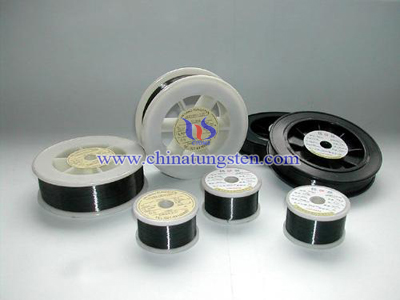
After drawing, tungsten wire undergoes chemical cleaning, acid pickling, or surface annealing to produce black or cleaned tungsten wire. Black wire retains lubricants for further processing, while cleaned wire removes surface impurities for better vacuum and electron emission performance. CTIA inspects diameter, tolerance, and surface condition to ensure consistency. Customized surface treatments are also available.
7. CTIA's Tungsten Wire Manufacturing Process / Packaging and Delivery
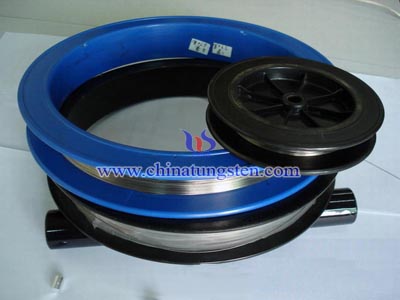
Tungsten wire is packaged in straight lengths or coils to prevent moisture, oxidation, and mechanical damage. Coils can reach tens to hundreds of meters, while straight wires are cut to specified lengths. Final inspection is conducted before shipment. CTIA ensures purity and mechanical stability during transportation through optimized packaging solutions.
CTIA's Tungsten Wire Manufacturing Process Flow
CTIA's tungsten wire is used in microelectronics, filaments, industrial heating, high-temperature structures, and electron emission applications. It features high purity, uniform diameter, and smooth surface, providing good creep resistance and thermal stability. Through controlled processing and quality inspection, stable microstructure, electrical conductivity, and mechanical performance are maintained to meet various application requirements.
For any inquiry, please contact tungsten wire manufacturer: CTIA GROUP
Email: sales@chinatungsten.com
Tel: 0086 592 5129696 / 0086 592 5129595
Website: www.tungsten.com.cn
WeChat:

Related Products: