CTIA's Tungsten Wire Selection Guide
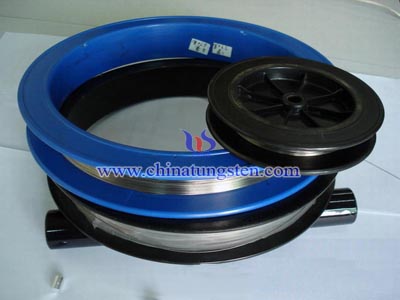
CTIA's tungsten wire is widely used in high-temperature heating systems, vacuum electronic devices, and precision processing equipment. Proper selection of tungsten wire is critical to ensuring stable long-term operation. CTIA's tungsten wire is widely used in industrial high-temperature and electronic applications due to its high melting point, low thermal expansion, high mechanical strength, and stable electrical resistivity. CTIA provides professional selection guidance and optimization support based on material purity, diameter, tensile strength, and application environment. Proper selection improves equipment service life, enhances processing efficiency, and ensures consistent product quality.
1. Purity and Doping of Tungsten Wire
Material purity directly affects the high-temperature performance and mechanical strength of tungsten wire. Low-purity tungsten wire is more prone to oxidation or fracture at elevated temperatures, reducing system stability. CTIA's tungsten wire is primarily produced from high-purity tungsten powder, with trace additions of aluminum (Al), potassium (K), and silicon (Si) to form AKS doped tungsten wire and improve creep resistance and ductility.
Higher-purity tungsten wire exhibits improved electrical stability at high temperatures, with a resistivity of approximately 5.3–5.5 μΩ·cm at room temperature, making it suitable for precision heating and electron emission applications.
In doped tungsten wire, potassium content is typically controlled at 60–120 ppm, with trace additions of aluminum (Al) and silicon (Si), forming a stable bubble-row microstructure. This structure significantly increases recrystallization temperature to approximately 1600–2000°C and improves creep resistance and mechanical stability without compromising electrical performance.
2. Diameter, Tolerance, and Geometric Shape of Tungsten Wire
Diameter and tolerance are critical parameters in tungsten wire selection. CTIA offers tungsten wire across a diameter range from 0.05 mm to 2.0 mm, with strict tolerance control depending on application grade.
Ultra fine tungsten wire with a diameter of 0.05–0.3 mm is used in precision applications such as electron beam evaporation and micro heating elements, requiring high dimensional accuracy with a tolerance controlled within ±0.003 mm to ensure fast thermal response and precise energy delivery.
Fine tungsten wire with a diameter of 0.3–1.0 mm is widely used in industrial heating systems and vacuum furnace applications, providing a balance between current-carrying capacity and thermal stability, with a typical tolerance of around ±0.005 mm.
Coarse tungsten wire with a diameter of 1.0–2.0 mm is used in high-current and structural applications, including large vacuum heating systems, offering higher load capacity and a slower heating response, with tolerance typically controlled within ±0.01 mm.
Diameter directly determines key performance characteristics, including current-carrying capacity, heating rate, and thermal uniformity. Thinner wire heats up faster and is suitable for precision and rapid thermal response applications, while thicker wire supports higher current and is better suited for large-scale heating systems.
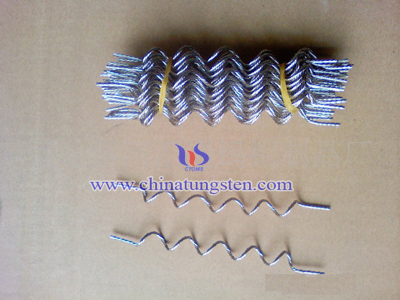
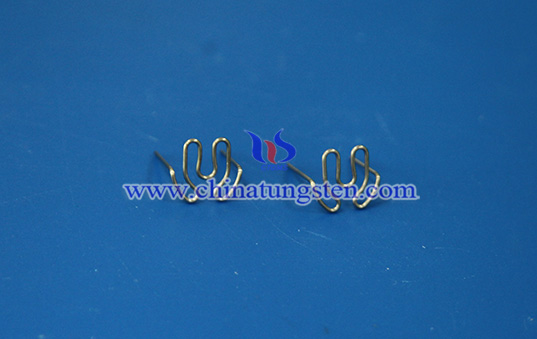
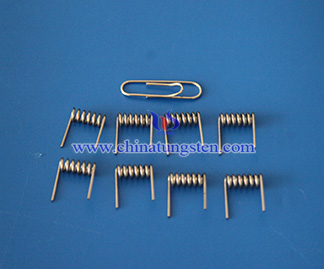
Tungsten wire can also be processed into straight, spiral, or corrugated forms to optimize surface area, improve heating efficiency, or meet structural requirements. Coil diameter, pitch, and length must be designed according to heating uniformity, power density, and mechanical constraints.
3. Mechanical Properties and High-Temperature Resistance of Tungsten Wire
Mechanical performance is one of the core criteria in tungsten wire selection. Tungsten wire typically has a tensile strength of 700–1000 MPa and excellent creep resistance, making it suitable for long-term high-temperature operation. Through repeated cold drawing and heat treatment, the grain structure is optimized to enhance fracture resistance and thermal stability.
Elongation is generally 1–3%. Fine tungsten wire may fracture under local overheating in high-power or rapid heating conditions, so both tensile strength and ductility must be considered during selection.
4. Electrical Properties of Tungsten Wire
Tungsten wire has a resistivity of approximately 5.6 μΩ·cm and a low temperature coefficient, enabling stable current distribution at high temperatures. For high-power heaters and electron beam evaporation systems, high-purity materials help prevent localized overheating and current imbalance.
Selection should be based on rated power, current density, and operating temperature to determine appropriate diameter and length, ensuring uniform and safe heating. For example, in electron beam evaporation with a power density of 10 W/mm², high-purity tungsten wire with a diameter of 0.1–0.2 mm ensures stable evaporation performance.
5. Surface Condition and Applications of Tungsten Wire
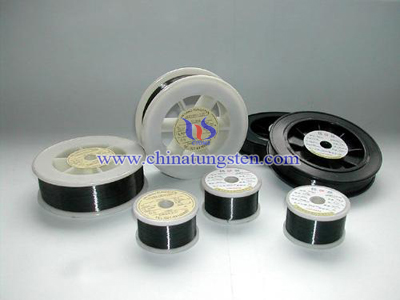
Surface condition significantly influences heat distribution, resistivity uniformity, and service life. In air or oxidizing environments, tungsten wire is susceptible to oxidation at elevated temperatures and typically requires inert gas or vacuum protection to ensure stable performance. In high-vacuum or inert gas atmospheres, high-purity tungsten wire can operate directly under controlled conditions without additional surface treatment. The surface types of tungsten wire are as follows: cleaned tungsten wire with a bright surface and black tungsten wire with an oxidized surface.

CTIA recommends that tungsten wire selection should be based on system-level optimization, considering purity, diameter, tolerance, mechanical and electrical properties, surface condition, and operating environment. For example, vacuum furnaces typically use 0.3–0.5 mm high-purity wire (W ≥ 99.95%), electron beam evaporation uses 0.1–0.2 mm high-strength wire, and micro-heaters use 0.05–0.1 mm wire for uniform heating performance.
Selection directly affects equipment stability and service life. With strict quality control, CTIA's tungsten wire ensures consistent performance across research, industrial heating, and precision electronic applications.
For any inquiry, please contact tungsten wire manufacturer: CTIA GROUP
Email: sales@chinatungsten.com
Tel: 0086 592 5129696 / 0086 592 5129595
Website: www.tungsten.com.cn
WeChat:
Related Products: